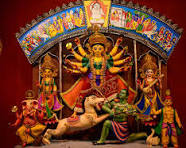
 This transformation is particularly significant given that India continues to struggle with high rates of violence against women, yet the festival itself celebrates Goddess Durga—the ultimate embodiment of feminine power and strength.
In West Bengal, Durga Puja organizers commonly use their pandals as a platform to address social concerns. Recent celebrations have broken away from purely religious themes to tackle uncomfortable social realities. Organizers have tried to convey messages about women’s safety, with some pandals showcasing themes related to high-profile violence cases like the RG Kar Hospital incident.
The 2024 celebrations were particularly poignant. Kolkata stood at a crossroads between tradition and change, torn between devotion to goddess Durga, symbolizing strength, protection, and justice, and the harsh reality of daily violence and injustice faced by women. The Binogram North Para Durga Puja carried the message “stop violence against women” in its 79th year.
Beyond addressing violence, the festival has evolved to promote broader inclusivity. Pandal themes have included celebration of sex workers, marginalization of transgender persons, and womanhood itself. Sindoor khela, previously limited to married women, is now open to all—including sex workers and transgender women. Some pandals have featured replicas of decorated women military officers like Colonel Sophia Qureshi and Wing Commander Vyomika Singh as powerful symbols of women’s strength and leadership.
This represents a significant shift—using one of India’s most beloved festivals to hold up a mirror to society’s contradictions, forcing communities to confront the gap between worshiping female divinity and failing to protect living women.. Dr. Nandini Bhowmik, along with Ruma Roy, Semanti Banerjee, and Paulomi Chakraborty—four female priests—conducted all the Durga Puja rituals at South Kolkata’s 66 Pally Durgotsab, breaking gender stereotypes for the first time in 2025.
Dr. Nandini Bhowmik is a Sanskrit scholar and Indologist from Kolkata who has been pioneering as a female priest, challenging patriarchal traditions in Indian weddings and Durga Puja rituals as co-founder of Shubhamastu, where she and her team of women priests conduct ceremonies that highlight gender equality, revising and omitting outdated practices to create inclusive, meaningful, and progressive celebrations.
This was particularly significant because for centuries, male Brahmins have held the exclusive right to perform Durga Puja rituals, and this was the first time in Bengal that women priestesses performed these sacred duties. The puja committee themed their celebration as ‘Mayer Haate Mayer Abahon’ (Mother goddess will be worshipped by mothers), declaring it ‘Durga Pujor Itihase Ei Prothom’ (first in the history of Durga puja).
The symbolism is powerful—women worshipping the ultimate symbol of feminine divine power challenges the patriarchal gatekeeping that has long excluded women from performing religious rituals. It directly confronts the contradiction of a society that venerates goddesses while restricting women’s religious authority and autonomy.